













We challenged developers at Devoxx Belgium to build and deploy a real application, with a real database, in roughly 15 minutes. We gave them a little help from AI, a Belgian twist, and some LEGO as motivation. Here’s what happened.
I’ve been attending Devoxx Belgium for almost 20 years. It’s one of those conferences that means a lot to me, both personally and professionally. It’s where I got the inspiration to create what would eventually become FinistDevs, where I started imagining myself as a conference speaker, and where, a few years later, I discovered that Developer Relations could actually be a job.
So when Clever Cloud decided to sponsor Devoxx Belgium this year, I was particularly happy.
But there was one question I wanted to answer before arriving in Antwerp: what could we do at our booth that would be genuinely interesting for developers?
Of course, we wanted people to discover Clever Cloud. That’s why companies sponsor developer conferences in the first place.
But I didn’t want to spend three days telling people how easy it is to deploy an application on our platform.
I wanted them to experience it.
And that’s how the 15-minute Clever Cloud Challenge was born.
Stop Prompting. Start Shipping.
The idea was pretty simple.
Come to our booth. Open your laptop. Build a tiny application. Connect it to a real database. Deploy everything on Clever Cloud.
And do it in roughly 15 minutes.
There were only a few rules:
- Any stack. JavaScript, Python, Java, Go, whatever you prefer.
- Any AI. Claude, ChatGPT, Gemini, Copilot, or your favorite coding agent. We didn’t care.
- A little Belgian flavor. Fries, beer, comics, cycling, Magritte, Devoxx itself. Anything vaguely connected to Belgium.
- A real database and a real deployment. Not a mockup, not a screenshot, not an application running only on your laptop. Something publicly accessible, with data that actually persists.
And because 15 minutes is a target, not a reason to punish someone for spending a little longer debugging, we weren’t particularly strict about the stopwatch.
The important thing was to ship something.
We prepared a dedicated challenge page with instructions, a starter prompt people could copy into their favorite AI assistant, and a coupon giving them €200 in Clever Cloud credits, valid for six months.
The prompt suggested three small application ideas, helped the participant choose one, and guided them through development, database creation, and deployment.
We also added a little incentive: everyone who successfully completed the challenge could enter a daily LEGO draw. Because, well, LEGO.

But there was no jury, no ranking, and no prize for the most sophisticated application. A tiny, functional app had exactly the same chance of winning as an ambitious one.
We weren’t organizing a hackathon, we were inviting developers to discover a platform by actually using it.
40 developers. 48 deployed applications.
And it worked.
Over the three days, 40 developers created and deployed an application with a real database on Clever Cloud.
I want to insist on that number for a moment.
Not 40 people who scanned a QR code, not 40 email addresses collected at a booth, not 40 coupons handed out.
40 developers who actually built something, provisioned a database, deployed their application, and came back to show us what they had shipped.
For me, that’s a much more interesting result than the number of people who walked past our booth.
And the best part? What they built.
We deliberately kept the challenge open-ended. We didn’t provide a template application or a predefined tutorial that everybody had to follow.
We gave people a goal, a few constraints, and the freedom to be creative.
The results were far more varied than I expected.
Some of my favorite applications
I couldn’t possibly feature all 48 applications here, but I wanted to share a few that particularly caught my attention.
Not necessarily because they were the most technically sophisticated, but because they were fun, original, or made particularly good use of the challenge’s constraints.
It’s Raining Devs: Magritte meets Devoxx
This one is probably among my favorites.
Take René Magritte’s surrealist paintings, add a crowd of developers attending Devoxx, and turn the whole thing into an interactive, collaborative artwork.
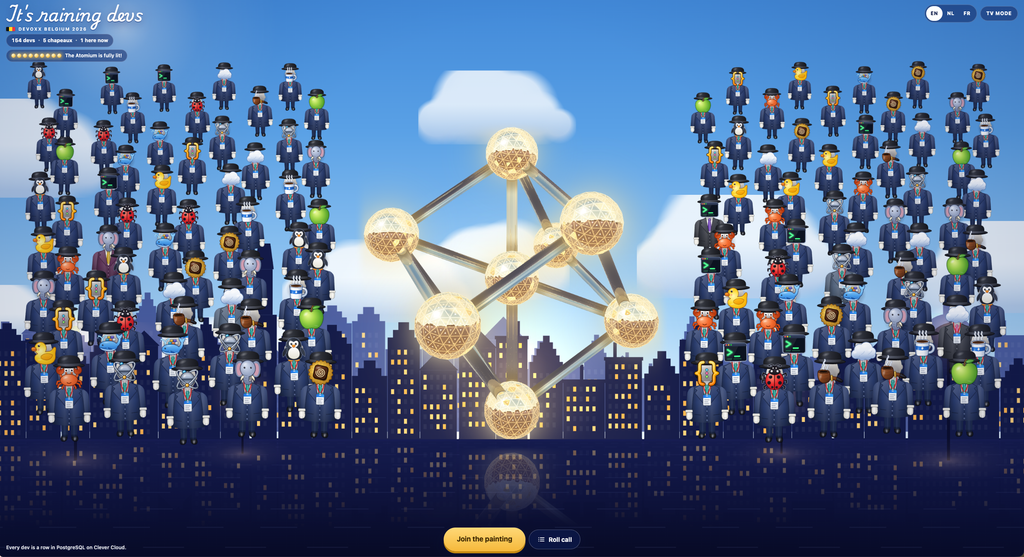
Participants can create their own floating developer, choose what hides their face, give themselves a name, and join the painting.
And those developers aren’t just temporary elements rendered in a browser. Each one is stored as a record in PostgreSQL on Clever Cloud.
There are even little interactions, a roll call, and postcards you can save or share.
I love this one because it combines something very Belgian, a genuinely playful idea, and a database that is an integral part of the experience.
It also illustrates something I really appreciate about these coding challenges: a tiny application doesn’t have to be a boring application.
Roll for Waffle: let the dice decide your destiny
What happens when you combine Belgian waffles with polyhedral dice, the kind you would normally use in a tabletop role-playing game?
You get Roll for Waffle, and I absolutely love it.
The concept is wonderfully simple: instead of choosing your waffle ingredients, you let the dice decide.
First, roll for your waffle base. Then roll for your primary topping. And finally, roll for a secondary topping. Each roll comes with a lovely animated polyhedral die, and the result is added to your creation.
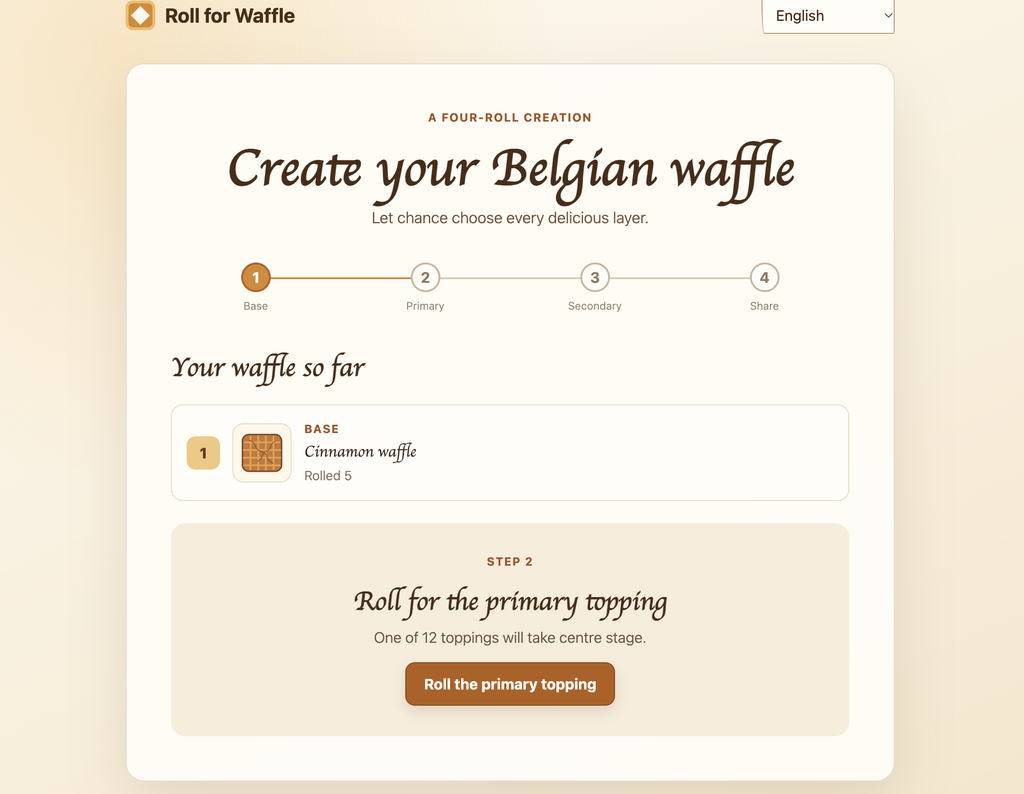
Will you end up with a classic Liège waffle covered in speculoos spread and fresh strawberries? Or some completely improbable combination that no Belgian pastry chef would ever dare to serve?
That’s the beauty of it. You don’t get to choose. The dice have spoken.
And once your creation is complete, you can share your randomly generated masterpiece.
As someone who has spent a ridiculous number of hours rolling polyhedral dice over the years, this one immediately made me smile.
It’s a perfect example of what I loved about the challenge: give developers a simple theme, a little freedom, and the opportunity to experiment, and they’ll come up with ideas you would never have imagined yourself.
Now, if you’ll excuse me, I have a waffle to roll.
Devoxx Bingo: because every conference has its clichés
If you’ve attended enough developer conferences, you know that some things are almost guaranteed to happen.
Certain expressions will be repeated. Certain technologies will be mentioned. Certain conference moments will feel strangely familiar.
Why not turn that into a bingo game?
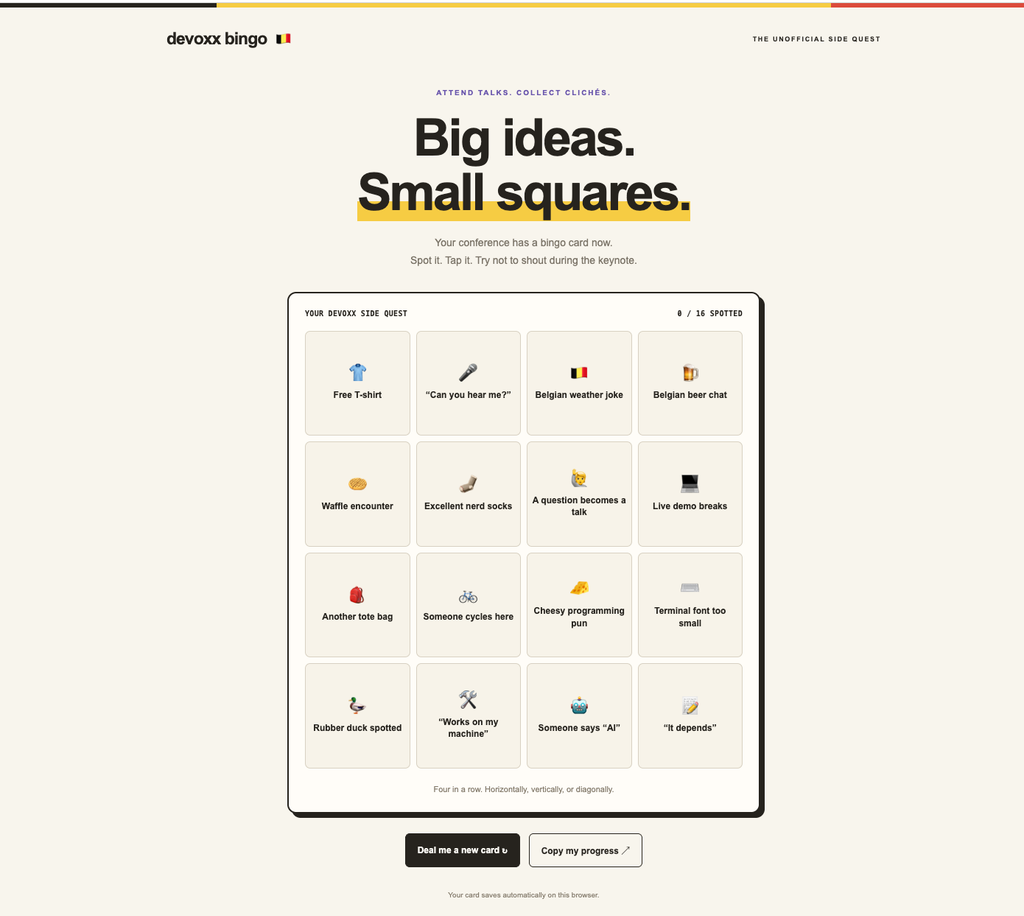
Devoxx Bingo gives you a card of conference clichés to spot during the event. Mark them as you encounter them, and try to complete a row.
It’s presented as an unofficial side quest, with absolutely no prizes and some very questionable bragging rights.
Exactly the kind of application that makes me smile.
And honestly, I can imagine people actually using it during a conference.
Devoxx YouTube Search: rediscovering conference talks
Devoxx has an incredible collection of recorded conference talks on YouTube, accumulated over many years.
And as someone who has been attending Devoxx for almost two decades, I love the idea of making that knowledge easier to explore.
That’s the idea behind Devoxx YouTube Search, another application created during our challenge.
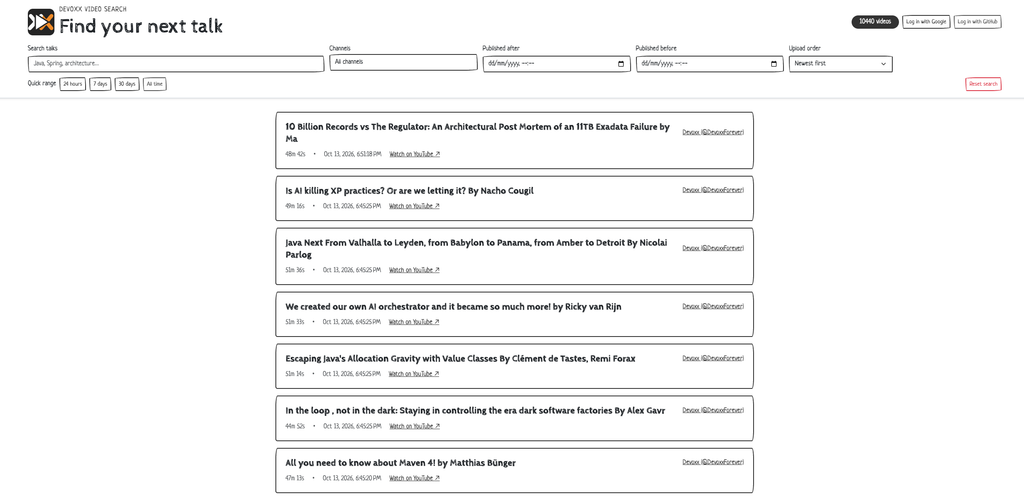
What I particularly appreciate is the choice of subject. While many participants went for something playful or distinctly Belgian, this developer chose to build something directly connected to the conference and its content.
It’s a lovely reminder that a challenge like ours doesn’t have to produce just games and experiments. It can also inspire tools that address real needs within the developer community.
BelgiQ: how Belgian are you, really?
BelgiQ describes itself as « Le quiz qui a la frite ».
That’s already a good start.
It’s a Belgian-themed quiz, available in French, Dutch, and English, with a leaderboard.
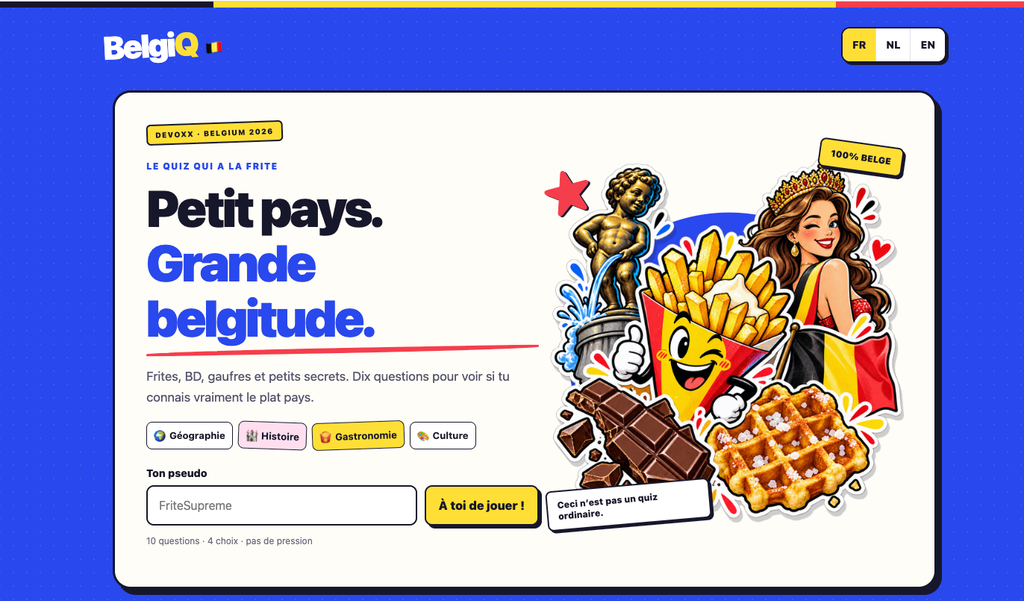
But what makes this application particularly interesting is that its creator, Gwenaël Jakab, shared his experience on LinkedIn.
Gwenaël decided to build BelgiQ using Node.js, Express and PostgreSQL. He used ChatGPT to prepare his prompt, then handed implementation and deployment to ChatGPT Work.
15 minutes later, he had a working application. After another 10 minutes of reviewing the result, making adjustments and requesting some refactoring, he had a V2 he was happy with.
And he hadn’t written the application code himself.
What I particularly appreciated about his post was his perspective on the developer’s role. Even when an AI agent handles implementation, someone still needs to make architectural decisions, define requirements, review the code and validate the result.
That’s an important distinction, and one that sometimes gets lost in discussions about AI-assisted development.
For me, his experience also illustrates exactly what we were hoping to achieve with the challenge: let developers focus on what they want to build, while discovering how straightforward it can be to deploy it on Clever Cloud.
And the best part? You can try BelgiQ yourself.
Friesdvisor: the important questions in life
Forget restaurant recommendations.
We’re in Belgium. We need to talk about fries.
Friesdvisor is a directory where you can search for a friterie or a town and add new places.
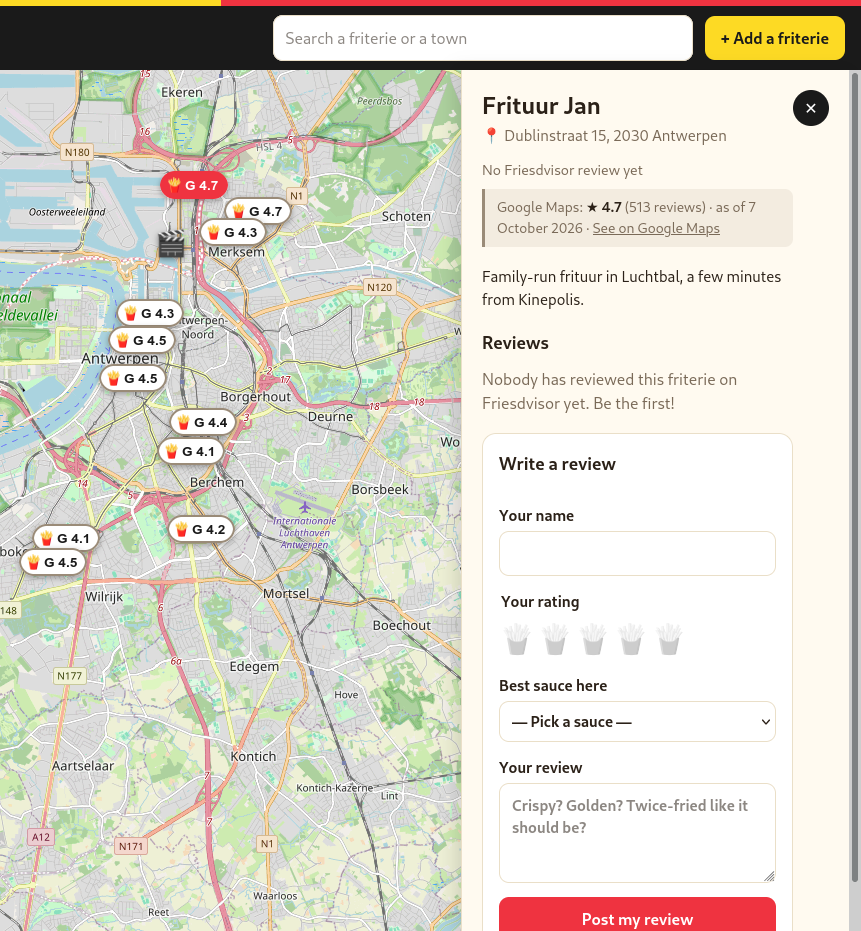
It’s a wonderfully straightforward idea, and exactly the kind of Belgian connection we were hoping people would invent.
I particularly like that it’s not just a joke. It’s a concept that could grow into a genuinely useful little community application.
And, of course, it needs somewhere to store all those friteries.
48 applications, and plenty more creativity to discover
These are just a few of my personal favorites.
But one of the things I loved most about the challenge was the sheer variety of ideas. Give 48 developers the same starting point, the same constraints, and roughly 15 minutes, and you get 48 different interpretations of what a tiny application can be.
Some went for games. Others built practical tools. Some embraced Belgian culture, while others found inspiration in the conference itself.
And I couldn’t possibly do justice to all of them in a single blog post.
That’s why we created the Built at Devoxx Belgium gallery, where you can explore the applications that participants chose to share publicly.
👉 Explore the Clever Cloud Challenge Gallery
Have a look around. Try the applications. See what people came up with.
And if one of them makes you smile, or gives you an idea for something you’d like to build yourself, then I think our little experiment has already achieved something pretty cool.
What did we learn?
A few things stood out to me during those three days.
First, developers are remarkably creative when you give them just enough constraints.
The Belgian theme was deliberately vague. We didn’t want people spending ten minutes wondering whether their idea qualified.
A Belgian dish? Great.
A reference to a Belgian artist? Perfect.
A joke about Devoxx? Absolutely.
That small creative constraint gave people somewhere to start without telling them exactly what to build.
Second, AI coding assistants make this kind of exercise much more accessible.
Not everybody arrived with a project idea, a favorite framework, or a clear understanding of how to provision and connect a database. But with a little guidance, they could go from an idea to something running online surprisingly quickly.
Gwenaël’s experience with BelgiQ illustrates another important point: AI-assisted development doesn’t remove the developer from the process. It changes what the developer spends their time doing.
The developer still makes decisions, defines requirements, reviews the results, and takes responsibility for what gets shipped. Meanwhile, the coding agent can handle much of the implementation work, and the platform takes care of the infrastructure.
Of course, the AI didn’t magically eliminate every problem. There were still deployment questions, configuration issues, and moments when someone needed a little help. That’s why we were there.
But the combination of AI-assisted development and a platform that takes care of the infrastructure made it possible to focus on the interesting part: building and shipping the application. And that’s exactly what we wanted people to experience with Clever Cloud.
Finally, I was reminded of something fundamental about Developer Relations.
Showing people how something works is useful. Helping them discover it for themselves is even better.
I could have spent fifteen minutes explaining how Clever Cloud handles deployments, databases, environment variables, and application hosting. Instead, developers spent those fifteen minutes doing it. And at the end, they had something of their own to show.
That’s a very different conversation to have at a conference booth.
What’s next?
The challenge doesn’t have to end at Devoxx.
Everyone who participated received €200 in Clever Cloud credits, valid for six months after activation. That gives them the opportunity to keep experimenting, improve their application, or start something completely different.
We’re also thinking about how to extend the experience with additional small challenges, encouraging participants to explore more of the platform.
And I’d really like to repeat this experiment at other conferences.
The Belgian theme worked beautifully at Devoxx Belgium. Imagine what developers could come up with at conferences in other cities or countries.
We already have a few ideas.
Your turn. Stop prompting. Start shipping!
I’ve attended a lot of developer conferences over the years, on both sides of the booth. I’ve distributed stickers, handed out T-shirts, given demonstrations, answered technical questions, and had countless conversations about cloud platforms. I still love all of that.
But watching someone arrive at our booth with nothing more than an idea, then return a little later with a working application deployed on Clever Cloud? That was particularly satisfying.
And seeing the creativity of those 48 developers made the whole experiment worthwhile.
So, to everyone who participated in the challenge at Devoxx Belgium: thank you!
Thank you for taking the time to try Clever Cloud, for embracing the slightly ridiculous Belgian theme, and especially for showing us what you built.
Want to give it a try?
Good news: you don’t need to attend Devoxx to take the challenge!
The original Devoxx Belgium Challenge is still online, and we’ve also created a generic version of Stop Prompting. Start Shipping. that anyone can try, anywhere.
The special €200 Devoxx coupon is no longer available, but every new Clever Cloud account comes with €20 in free credits, which is more than enough to build and deploy a small application with a database.
Pick a theme. Open your favorite AI coding assistant. Give yourself 15 minutes.
Build something fun, connect a database, and deploy it.
And if you do, I’d genuinely love to see what you come up with. Share your application with me!
Stop prompting. Start shipping.