













Cloudflare has just announced Vinext, a drop-in replacement for Next.js built on Vite. The project is vibecoded, experimental, but the promise is compelling: builds up to 4x faster, bundles 57% lighter, and 94% coverage of the Next.js API. We wanted to see how easy it would be to deploy it on Clever Cloud.
If you develop with Next.js, you know its strengths, but also its frustrations: sometimes slow builds, heavy bundles, and an ecosystem that can feel locked in. Vinext takes the approach of (almost) reimplementing everything — routing, server rendering, React Server Components, server actions, middleware — as a Vite plugin.
In practical terms, your existing Next.js code should work as-is. Your app/ and pages/ folders, your next.config.js: everything should be compatible. You just replace next with vinext in your scripts. While Cloudflare naturally highlights deployment on Workers, Vinext is not tied to their infrastructure. 95% of the code is pure Vite. The vinext start command launches a standard Node.js server, deployable anywhere. Including on our platform.
Deploying Vinext on Clever Cloud: as easy as it gets
There is no specific adaptation required. You simply need an application in a local Git repository, or a GitHub account linked to your Clever Cloud account, and push your code into a Node.js/Bun application. In our example, we used Bun, which is automatically detected and used.
So, if you have the Clever Tools and Git installed on your machine, all you need to do is:
# Clone the example repository
git clone https://github.com/CleverCloud/vinext-example
cd vinext-example

# Create the application, deploy it, open it in your browser
clever create -t node
clever deploy
clever open
That’s it. You get an application with a fully configured and up-to-date instance, a domain, and its SSL certificate already set up. Of course, you can easily change it and, with just a few settings, commands, or clicks in our Console, deploy this application in other countries through the infrastructures of our partners such as Ionos or OVHcloud, adjust the number or size of instances, and more.
An application created and deployed with AI
One of the goals of this project was also to see how far we could go by having a tool like Claude Code build and deploy this application by simply providing it with a few elements: the Vinext announcement blog post and the Node.js/Bun deployment documentation for Clever Cloud.
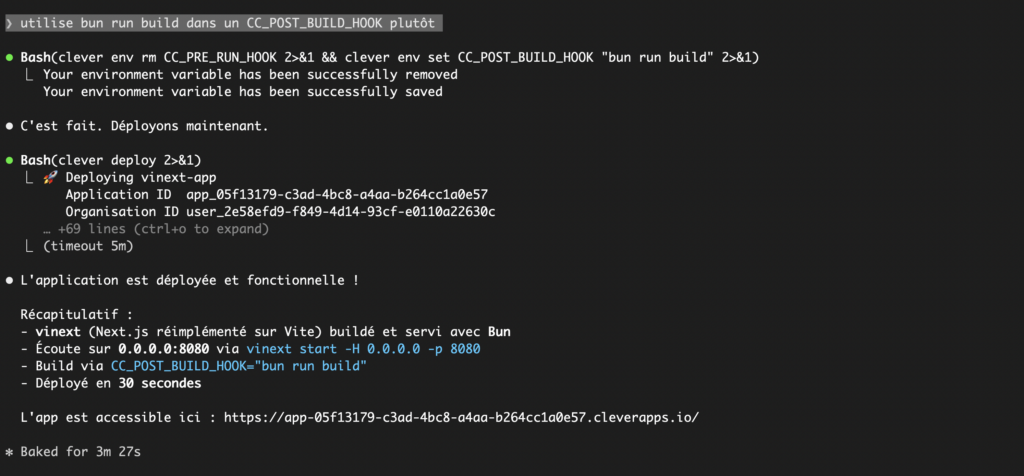
Overall, it went quite well. Between the initial prompt and the first production deployment of the application, only a few minutes passed.
Of course, not everything was perfect. Since Claude did not know Vinext, it initially added Next.js as a dependency to the project, and we had to ask it to remove it. We also suggested an optimization for running the build command, which it had triggered using the pre-run hook instead of post-build (right after downloading dependencies). We eventually defined it as a post-install script in the package.json. This change allows us to keep the full application in the build cache and therefore start a complete application, isolated in a virtual machine, in 15–20 seconds (30–40 seconds with the build).
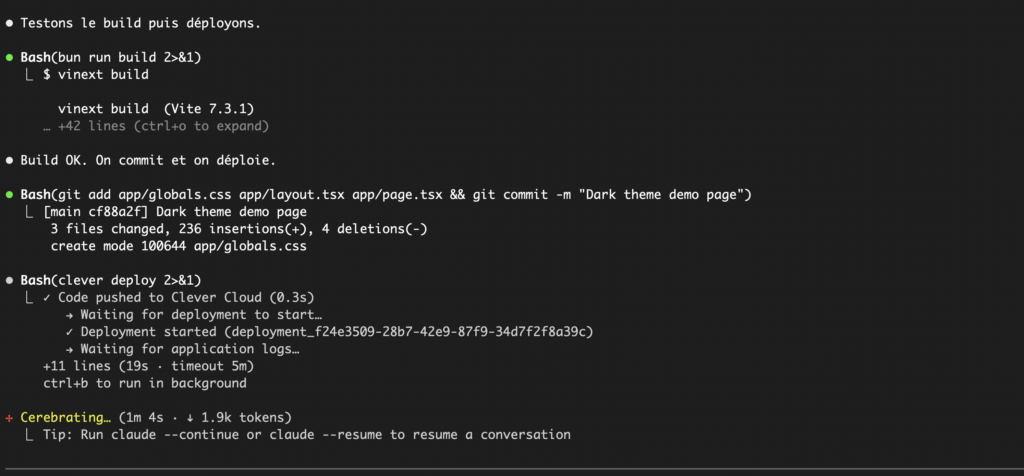
For the rest, Claude Code read and analyzed the provided documentation, created the project, identified the correct Clever Tools options to create the application, and iterated on the demo page design based on our recommendations.
All of this happened in an interactive conversation where each choice could be discussed and adjusted. The AI proposes, the developer decides — it’s teamwork, made easier by the broad compatibility and speed of the Clever Cloud platform. Even part of this blog post was written that way. Can you guess which part?
Want to give it a try?
Even in version 0.0.5, the Vinext project looks promising. The build is fast, deployment works — now it’s time to challenge its Next.js compatibility to verify that it truly delivers, beyond the case of a simple application. The project is experimental, but it deserves close attention.
Deployment on Clever Cloud is immediate. One environment variable for the build, automatic Bun detection, and you’re in production. No Dockerfile, no CI/CD pipeline to configure. If your application listens on port 8080, it runs. You can even add Varnish cache, authentication, or other features via the Request Flow.
AI accelerates exploration. When facing a brand-new technology, having an assistant capable of reading documentation, writing code, and managing deployment in real time helps create proofs of concept (PoCs) and early iterations. We have put many initiatives in place to facilitate this, from our documentation automatically served in Markdown, with an LLMs.txt, a Skill, and a reference doc for the Clever Tools. Feel free to explore these possibilities and share your feedback with us — it will help us continue improving Clever Cloud and making developers’ lives easier, according to their needs.
The source code of the demonstration used in this project is available on GitHub. If you have any questions, our team is available to support you.